
- PEPTIDE THERAPY
Peptides: Small Molecules — Big Potential
Understanding Peptide Therapy
Peptide therapy is one of the most exciting areas of medicine to us here at Wellness Medical Clinic and Thyroid Treatment Center.
What if we could communicate with the body at the cellular level?
Peptides are essentially amino acids that improve cell signaling in the body. They have many functions essential to health and longevity.
Our peptide therapies are easily injected, thereby delivering them directly to the bloodstream where they can circulate throughout the body.
909-860-2610
- BIOLOGICAL MESSENGERS
Think of Peptides as Messengers
Peptides are attracting increasing attention in medicine, wellness, recovery, and healthy aging. But what exactly are peptides—and what can they realistically do?
The simplest way to understand peptides is to think of them as messengers.
Peptides are short chains of amino acids that can send signals to cells and tissues, helping regulate processes such as hormone production, metabolism, tissue repair, inflammation, and other functions throughout the body.
Some peptides have been used as medicines for decades. Others are newer and are still being studied.
- THE BASICS
What Are Peptides?
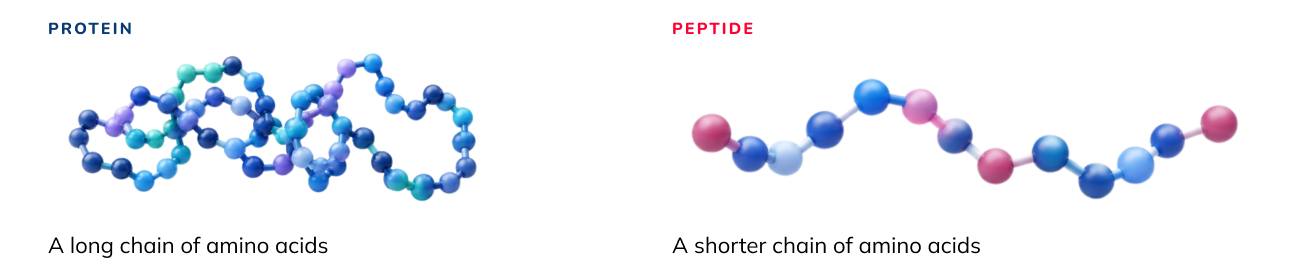
Proteins are made from long chains of amino acids. Peptides are essentially shorter chains of amino acids.
Your body naturally produces many different peptides. Some act as hormones, while others function as signaling molecules that tell cells what to do.
Depending on the peptide, these signals may influence:
01
Hormone production
02
Metabolism
03
Appetite and blood sugar regulation
04
Tissue repair
05
Collagen production
06
Muscle and bone biology
07
Inflammation and immune responses
08
Growth and development
Think of a peptide as a biological text message: a small molecule carrying a specific instruction to a cell.
- A LONG HISTORY
Are Peptides New?
No. Peptide-based medicines have been part of modern medicine for more than 100 years.
One of the best-known examples is insulin, which has been used since the early 1920s to treat diabetes.
More than 100 peptide-based medicines have been approved or developed for medical use, and research into new peptide therapies continues.
Other important peptide or peptide-based medicines include:
01
Growth hormone
02
Oxytocin
03
Calcitonin
04
Insulin
05
Modern GLP-1 medications, such as semaglutide
So peptide therapy is not simply a new wellness trend. Peptide medicines are an established part of modern medicine for a long time.
- HEALTHY AGING
Why Are Peptides Interesting
for Healthy Aging?
As we age, many biological processes change. Hormone levels can change, recovery may become slower, muscle mass can become harder to maintain, and the body’s ability to repair certain tissues may decline.
This has led researchers to investigate whether specific peptides can influence some of these processes.
Depending on the specific peptide and the condition being treated, researchers have investigated potential effects on areas such as:
- Sleep and recovery
- Skin and connective tissue
- Metabolism and Longevity
- Hormonal signaling
- Muscle preservation and performance
- Blood sugar and appetite regulation
- Mitochondrial repair
- Hair regrowth
However, potential is not the same as proven benefit.
A peptide that has demonstrated benefits for one medical condition should not automatically be assumed to improve longevity, reverse aging, or enhance performance in healthy people.
- HOW THEY’RE GIVEN
Why Peptides Are Usually Injections
One of the challenges with peptide medicines is that many peptides are fragile molecules.
When swallowed, digestive enzymes can break them down before they can reach the bloodstream in a useful form. Even after entering the circulation, some peptides are rapidly broken down or eliminated.
That is why many peptide medicines are administered by injection rather than as conventional tablets.
Some peptide therapies may be administered subcutaneously, meaning the medication is injected just beneath the skin. Depending on the medication, patients may be able to administer treatment themselves after appropriate instruction and medical supervision.
- PERSONALIZED CARE
Peptide Therapy Should Be Personalized
There is no single “anti-aging peptide.”
Different peptides have different structures, targets, mechanisms of action, evidence, dosing requirements, and potential risks.
The goal is not simply to prescribe a peptide because it is popular.
For this reason, a responsible peptide program should begin with an assessment of your:
01
Medical history
02
Current medications and supplements
03
Symptoms and health goals
04
Relevant laboratory testing
05
Existing medical conditions
06
Individual risk factors
The goal is to determine whether a particular therapy is appropriate for the individual and supported by enough evidence to justify its use.
- AN IMPORTANT DISTINCTION
FDA-Approved Peptides vs. Experimental Peptides
This distinction is extremely important.
Some peptide medications are FDA-approved for specific medical conditions and specific uses.
Other peptides promoted by wellness or longevity clinics may be compounded, investigational, or otherwise not FDA-approved for the particular use being promoted.
These categories should not be treated as equivalent.
If you are considering peptide therapy, ask:
01
What exactly is this peptide?
02
Is it FDA-approved?
03
If it is approved, what condition is it approved to treat?
04
If it is not FDA-approved for this use, what evidence supports using it?
These are important questions because the fact that a peptide exists—or that studies have been conducted on it—does not necessarily mean that its benefits and long-term safety have been established.
- PHYSICIAN-GUIDED
Our Approach to Peptide Therapy
At our clinic, peptide therapy is approached as a physician-guided medical treatment, not as a one-size-fits-all anti-aging program.
Dr. Shah reviews your health history, goals, medications, and appropriate laboratory information before determining whether peptide therapy is appropriate.
Where treatment is considered appropriate, the choice of peptide is based on its intended biological target, available evidence, and your individual circumstances.
Our approach is straightforward:
01
Understand the biology.
02
Evaluate the evidence.
03
Choose the treatment carefully.
04
Monitor the response.
- EVIDENCE OVER HYPE
Peptides Are Not Magic
Peptides are promising—and some are already well-established medicines.
But claims that a particular peptide can “reverse aging,” “regenerate everything,” or dramatically extend lifespan often go beyond what the current evidence can support.
The science is much more interesting than the marketing.
THE RIGHT QUESTION ISN’T:
“Which peptide is the best?”
IT IS:
“Is there a specific peptide with good enough evidence, for a specific purpose, that makes sense for me?”
That is where personalized, physician-guided peptide therapy can play a role.
- IN SUMMARY
The Bottom Line
Peptides are powerful biological signaling molecules. Some are established medicines with decades of clinical experience. Others represent exciting areas of ongoing research.
They may have applications in hormone therapy, metabolic health, tissue repair, recovery, and other areas of medicine—but the evidence varies considerably from one peptide to another.
Peptide therapy should be based on biology and evidence, not hype.
If you are considering peptide therapy for healthy aging, recovery, metabolism, muscle, or another health goal, a physician-guided evaluation can help determine whether it is appropriate for you.
Schedule a consultation to discuss whether peptide therapy may have a place in your personalized health and wellness plan.
909-860-2610
Small Molecules — Big Potential